Surface Contingencies
The most dangerous sport I’ve personally undertaken is practiced by some of the most careful people I have ever met. That sentence sounds wrong and it took me several years underwater to decide that, actually, it’s quite right.
I learned to scuba dive in the months following my first exit. I was in my mid-twenties with some spare time on my hands and a calling to take roads less travelled by. Over the next few years that calling carried me from open water scuba into wrecks, then into caves, then into trimix: all dives where the environment and/or gasses used require significant extra procedures to mitigate risk.
The strange paradox about more aggressive diving is that every step deeper is also a step more conservative. The recreational diver checks a gauge occasionally. The cave diver writes the entire dive (plus several plausible backup scenarios) on wet-notes before touching the water: gas volumes, turn pressures, deco schedules, bailout plans. The most aggressive exploration is done by the most procedural people, because the sport's history is unambiguous about the alternative.
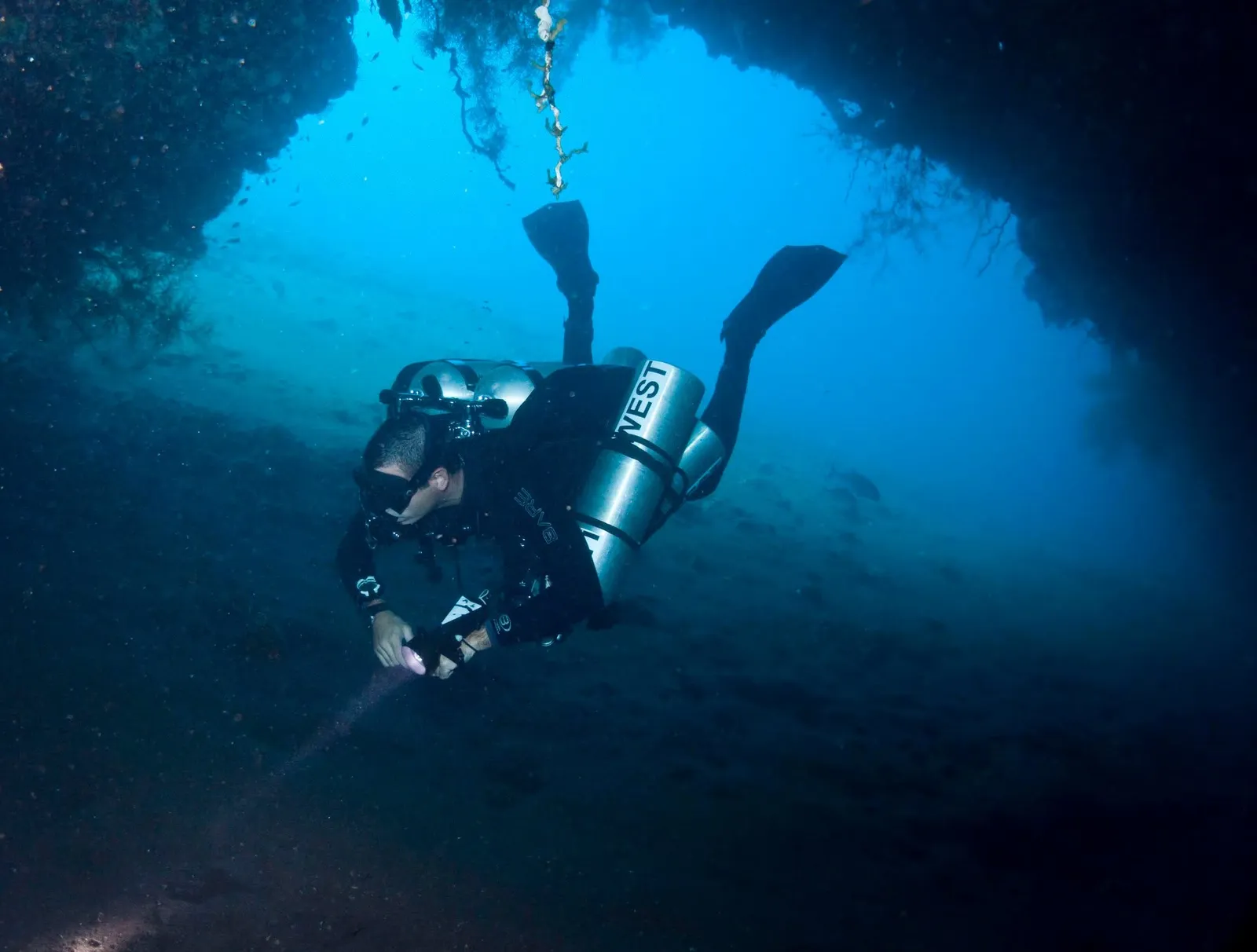
I don’t mean that in a hyperbolic sense. Cave diving's rules were written by its fatalities. Sheck Exley's "Blueprint for Survival," the founding safety text of the sport, is a systematic analysis of fatalities: who died, where, and which specific failure killed them. Out of a body count came five rules, and out of the five rules came a culture where each incident is dissected and published so the next diver inherits the lesson.
The first thing the culture teaches is that "dangerous" is a useless word. Nobody dies of danger. They die of a named thing: gas exhaustion, lost guideline, missed decompression, equipment failure without redundancy. A catalog of named risks, each with its own mitigation, each impacting a team’s plan. A risk unnamed is a risk unmitigated and may be the one that kills you or a teammate.
The second thing it teaches is a rule about where decisions get made. Never decide something at depth that you could have decided on the surface. A dive plan is not just a description of what you hope will happen. It is a set of decisions made in advance, in calm, turned into procedures: what you do when a light fails, when the guideline gets lost, when a gas reaches its mark, what conditions terminate the dive without question. Each tolerance is calculated before it is tested. For example, turn pressures are written in the plan at the surface and obeyed at depth without exception, because a diver at depth is task-loaded, invested, and the next dark, unexplored passage begs for light. The plan exists precisely because the people executing it cannot be trusted to safely write it on the fly.
The third thing is a rule about gas management, called the rule of thirds. A third of your gas going in, a third coming out, a third held in reserve for the failure that will eventually happen on a dive. The uninitiated may read this as timidity or leaving the last edge of exploration on the table. They have it exactly backward. The reserve is not what stops you from exploring; the reserve is what makes repeated exploration survivable.
Nobody penetrates far into a cave on bravado, or at least not for very long. Elite cave divers penetrate far on planned margins, with extensive underwater and surface support. The divers with the deepest, furthest exploration records are the ones with the best plans, the best support, and they can keep doing it because of the margins and support built into their plans. The entire team works together to set and reach the objectives. Running fresh line underwater is a function of the organization working as a system, not an individual’s courage.
All this systematization does not mean that extreme diving is completely safe. I have personally known three men who died underwater. One in a wreck, one in a cave, one on a trimix dive. All were extremely experienced. Two of them trained technical instructors for a living. The procedures are not a guarantee; they are an adjustment to the odds. And odds, held across enough dives, keep their own ledger. Hell, even Sheck Exley himself, the guy who literally wrote the book on this stuff, perished underwater. There is no level of skill at which the exposure stops accumulating. There is only the question of whether the risk is successfully mitigated during the n=1 of the dive at hand.
For me, as I grew older, that question eventually required more reflection. As any experienced investor would know, risk tolerance has two components. Willingness is how much risk you can stomach; ability is how much you can afford to bear, given what you owe and to whom. When the two disagree, ability wins. My willingness never changed. My ability did, when I decided to have a family. A carefully mitigated (but non-zero) probability, multiplied by every future dive, is an acceptable line item for a single man in his twenties. I determined that it is not one for a husband and a father. So, I surfaced, permanently.
I look back on that as the best risk decision my diving years produced, and I note that I made it on dry land, with a clear head, by the person I wanted to become rather than the person who wanted to light up one more unexplored cave.
What survived the sport is the habit, and the habit turned out to be applicable to many other things in life, particularly in starting businesses. The situations that ruin people in business are rarely surprises. They are risks that never got named, tolerances that never got set, and decisions left to be made in the moment by someone who is tired, invested, and wanting it to work. A founder eighteen months into a startup is at depth. An investor defending a markdown is at depth. Nearly every mechanism that actually protects people is a surface decision: a stop-loss set before a trade, kill criteria agreed before a startup pilot, a policy written before a crisis. We pre-commit not because we distrust our future intelligence, but because we anticipate future situations where short-term incentives and emotion can cloud sound decision making.
These days, I plan new companies like I planned cave dives: plan for the exploration path, but also plan scenarios to change course, fall to a backup and get everyone out alive.
Today’s startup world bundles all risks into one ticket, prices none of them separately, and leans on a heroic founder to make the hardest calls at maximum depth. I think you can run a pretty good simulation of the plan beforehand, with a clear head. Name the risks. Retire them one at a time, in order of what each one costs to resolve. Stage your commitments along the line, the same way an exploration team places stage bottles. Set the turn pressure before anyone is in the water, and size the reserves to match the ambition, because a startup’s runway is just gas management baked into a spreadsheet.
In short: make the decisions and set the contingencies at the surface, before the pressure mounts.